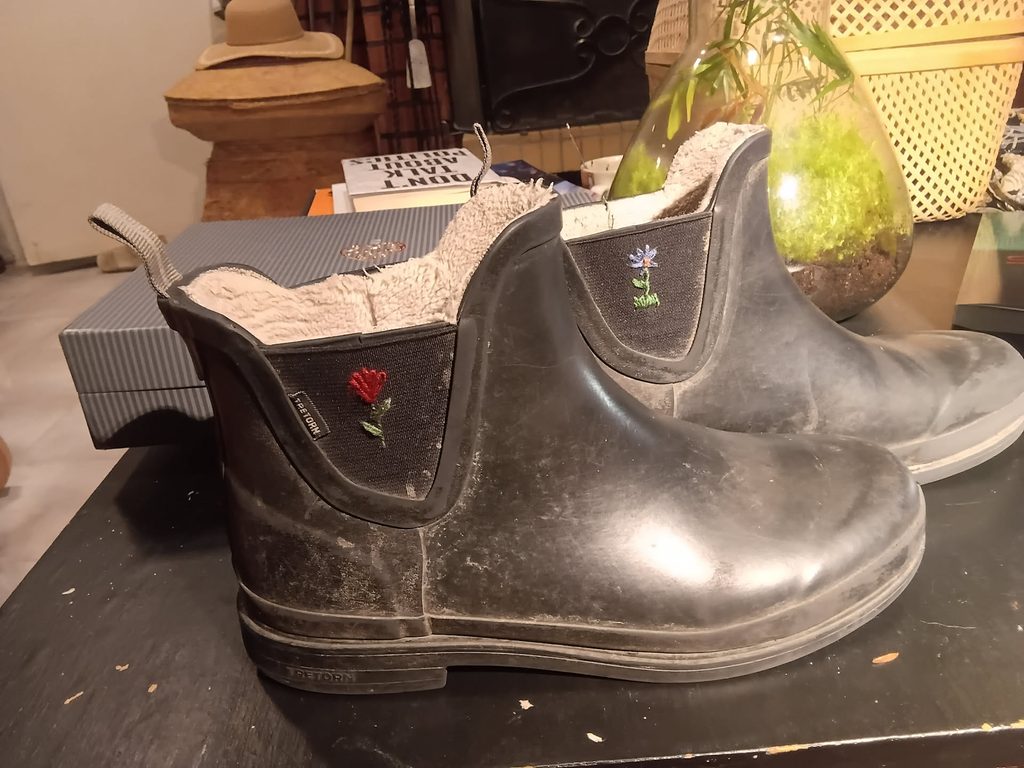
Online, currently, I see a lot of complaints about how “everything” or “every hobby” is getting AI-sloppified to extinction. And AI-slop sure is real. But in most cases, it is not the hobby that is being sloppified – it is the internet about that hobby. And The internet is indeed full of AI-generated pictures of embroidery, AI-generated paintings, and vibecoded sad excuses for games.
But my embroidery here at home is quite intact, thank you. The painting and the hobbyist coding projects by my family members? They are still there. My garden’s going to its winter slumber on schedule. I really should take the camera and go take some pictures of those gorgeous drops of water on the now bare cherry tree, too. No one’s knocked on the door, held us at gunpoint, and AI-sloppified that all.
Lately, a lot of us in various hobbies have become dependent on the internet and escpecially Big Tech “social” media for communication about our hobbies. Worse, some people for whom the things we love are not just a hobby but a livelihood, have come to depend on the internet for upkeep – food on the table, roof over their heads. Big Tech and their AI bros are taking that over: capitalism is doing its thing and commodifying the commons and exploiting everything to extinction. That’s horrible.
But my hobbies? They are still here.
Since the Big Internet is increasingly in the hands of Big Tech, we have to do this the old-fashioned way. Enjoy a thing because it is beautiful, not because you can tell the whole world it is beautiful. Meet locally, meet for real. Fediversify, de-centralize. Instead of connecting everything to everyone all the time, build loosely connected local networks. Form a club, go to church, join a book club or a sewing circle, whatever works for you. Slow down, do less, go back.
En tiedä kuinka monta kertaa tulen vielä toistamaan tätä, mutta jälleen kerran. Suomesta ei puutu työtä.
Tekemätöntä työtä on joka päiväkodissa ja koulussa, maatilalla ja terveysasemalla. Sitä lojuu teiden varsissa ja joutomailla, odottaa ulkovajassa ja autotallissa parempaa aikaa, varisee puista jalkakäytäville ja pihamaille, sataa taivaalta pakkasöinä. Taiteilijan mieli tuottaa sitä kuin itsestään, käsitöitä tekevä löytää sitä lankakaupasta, nikkaroija näkee vasaran ja sahan ja taikoo tekemättömän työn tyhjästä ilmasta. Lapset pitää hoitaa, ruokaa viljellä, tavaroita ja ihmisiä kuljettaa, teitä ja taloja rakentaa, sairaat parantaa, vanhukset ruokkia, kuolevia ja surevia lohduttaa. Työ ei meiltä tekemällä lopu.
Mutta kun kapitalismi sanoo, että Suomessa ei ole työtä, se ei tarkoita, että ihmisillä on tylsää, koska heille ei kertakaikkiaan löydy mitään hyödyllistä tekemistä. Sen sijaan “työpaikkojen puute” tarkoittaa, että emme kapitalistin mielestä riittävästi osta toisiltamme tarpeetonta tavaraa, tai teetä toisillamme tarpeetonta paperinpyörittely- tai excelintäyttelytyötä. Ihmisille kun ei haluta maksaa hyödyllisestä tekemisestä. (Lukusuositus: David Graeber, Bullshit jobs.)
Emmehän me edes ole nyt onnellisempia kuin olimme silloin, kun ihan kaikkea ei ollut saatavilla ihan koko ajan. Edes kaikkein rikkaimmat eivät ole kaikkein onnellisimpia. Miksi meidän pitäisi edes haluta järjestelmää, joka tuottaa rahaa ja tavaraa, mutta ei tyytyväisyyttä? Miksi sellainen järjestelmä olisi hyvä, jossa ihmisiltä loppuvat ruoka ja lääkkeet palkan puutteessa, mutta samalla tarpeellista työtä jää tekemättä? Miksi emme ennemmin edellyttäisi, että ne joilla on jo tarpeeksi, maksavat tarpeellisen työn tekemisestä niille, jotka sitä haluavat tehdä, ja että ne joilla on jo aivan liikaa maksaisivat eniten?
You have seen this post. Five ways to increase your mental health. Sleep, eat well, exercise, connect with people, blah blah blah. You know the drill. Follow all the rules about how to be a good health-conscious citizen and certainly impeccable mental health will follow, guaranteed. (Narrator: it is not guaranteed at all.)
But what if it was not your mental health but that of the community’s that you were trying to increase? Try these.
One. Increase the amount of inconsequential words you speak in a day. The number of words we speak in a day has gone down. Mostly, it seems, we have not lost meaningful words as much as we have lost everyday random encounters. This means that people have much less access to practice social connection in situations that feel safe because they are not important. It’s easier to not care if your voice sounds funny if you are saying hello to a rando getting on the same bus than when it is your crush. So speak a little more every day when than feels comfortable. Say good morning when you arrive to that bus stop. Ask for directions or the time instead of taking out your phone. Compliment a stranger on their choice of a shirt. Not because this is somehow “connection” or “community” – those things take more. But because it lets people practice.
Two. Let people help. When someone asks “do you need help with that” don’t jump into saying no, no, it’s no trouble, I got it. Even if you got it, let them help. Helping people is a good mood boost like few others. Give it to them.
Three. If a situation feels hurried or tense, but there is no actual immediate danger, slow down and release control. Don’t try to hurry it along or quickly fix it. Let it be. Likely it will fix itself, and if it does not, you have at least not made it worse, and you can still try and solve it.
Four. Everyone has quite enough random thoughts in their own head. No one needs more unfiltered random thoughts from other people. Filter what you share, don’t just re-toot everything that feels cool. Consider your audience – will they think this is cool? Be mindful of their time, too. Is this really a thing you want to add to their already busy heads day? And no, it is not “raising awareness” when you post a new detail about something everyone pretty much knows about already.
Five.Never make fun of someone when they change their mind for the better. If your child tells you he has realized he needs to work more for his math grade, don’t roll your eyes and point out that’s what you’ve been saying all school year, ask them how you can help. When someone post on social media that what’s happening in Palestine is genocide and that’s actually not considered good, or that maybe they should not have voted for Trump after all, don’t repost that saying “now they notice, lol”. Let them quietly slip on the side of good guys and let the past lie. No one likes to be reminded about the sins of their youth.
(Now if I could just remember to take my own advice!)
Something about how people debate AI has bothered me for a while. There seems to be artificial divisions. Some people think that the division is in knowledge and understanding: people who can use AI are pro it, people who object just don’t understand it or have not really tried it. Or people who use AI don’t just understand how many mistakes it can make and how biased it is, or how immoral, while people who do not use it are the ones who understand the issues.
The linked post is by someone who has tried, and who does know that with some measures efficiency does increase, and still objects. And the objections are quite familiar from a completely other context.
The term Luddite is often used these days to refer to a person who objects to new technologies out of backward thinking or unsubstantiated fear. The original Luddites, however, did not object to technology. They worried about its impact on products, professionals, and society.
Specifically, they worried that the use of machines might lead to mass unemployment to the people while the rich owners of them got richer still. They worried that while the cloth industry machines could produce a lot of material in a short time, the material would be of inferior quality, leading to the need to buy new things when the old ones broke, and thus to waste. They worried about physical safety in the factories, but also about the mind-numbing conditions of the factories, where the individual worker was disconnected from the product. They lamented that professional skill in making quality items would be replaced by unskilled labor mass-producing lower quality work.
Looking at the issues that current day’s fast fashion has given us, I don’t think they were wrong.
LLMs are the Spinning Jenny of software industry (and other forms of information industries). A development has started where it is easy to mass produce great amounts somewhat functional code, but the code produced is of lesser quality. It is not easily maintainable. It is not easily repairable. Producing it is mind-numbing and bad for one’s mental health. It reduces the skill needed by the programmer, and eventually the skill is lost. It concentrates profit in the hands of a few rich individuals getting richer still, instead of spreading it to those who produce it.
The programmer Brett C. I quoted in the beginning of the post is no more anti-technology than the Luddites were, as his homepage proves. He seems to love programming. He uses it for both work and play. What he does not like is mass-produced code and the effects the mass production has on the industry, on the product, on the people involved. And he is not alone.
Maybe in a decade or two we will have artisanal programmers and doctors whose services you can buy to self-care for yourself after you have spent a mind-numbing week at a program or health factory. Or maybe this time, we will have a successful neo-Luddite movement.
I, for one, conscientiously object to mass-produced science and mass-produced healthcare services. I believe we can do better, and in these fields, it is very seldom that faster is better.
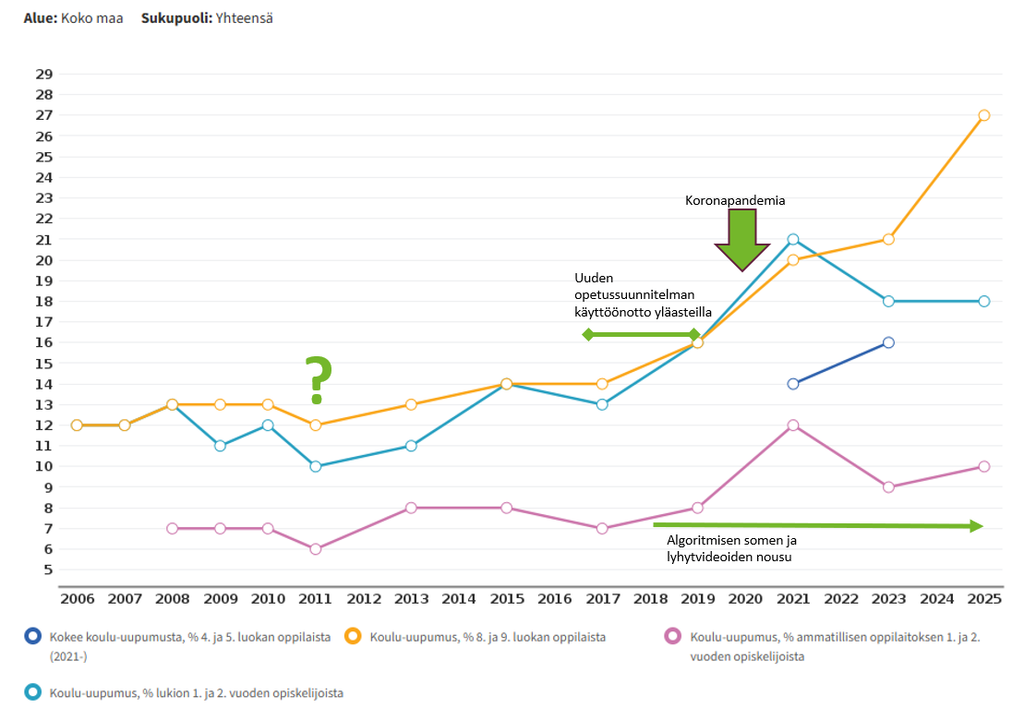
Kerroin paikalliselle yläasteikäiselle edellisestä blogikirjoituksestani ja kysyin, mitä syitä hän ajattelee ilmiön takana olevan. Kun kysyin, mikä nuoria ahdistaa, vastaus tuli kuin apteekin hyllyltä: maailmantilanne. Ilmastonmuutos, ankarien oikeistolaisten aatteiden nousu, Venäjän uhka. You know the drill. Samoja ne aikuisetkin doomscrollailee. Ehkä meiltä kaikilta voisi ottaa puhelimet pois ja rajoittaa uutisten seuraamista kertaan päivässä. Säästyneellä ajalla voitaisiin vaikka yrittää oikeasti tehdä oikeille ongelmille jotain.
Koulu-uupumuksen syykin nuorelle oli selvää, mutta hänen oli vaikea ensin löytää sille ihan oikeita sanoja. Koulu tuntuu painostavalta, hän sanoi. Monet opettajat muistuttavat koko ajan, että kaikki vaikuttaa arvosanaan. Jos on sääntö, että saa olla korkeintaan kolme koetta viikossa, sitä kierretään niin että sanakoetta ei lasketa, projektin palautusdeadlinea ei lasketa, pistareita ei lasketa. Ne kuitenkin arvostellaan ja vaikuttavat arvosanaan siinä missä koekin. Tuntiaktiivisuus vaikuttaa arvosanaan, ja jotkut opettajat laskevat jopa tukkimiehen kirjanpidolla, kuinka monta kertaa kukakin viittaa. Useat vihkot kerätään lukuvuoden lopussa pois ja tarkastetaan – ei vain sen osalta, onko tehtävät tehty, vaan sen osalta, kuinka hyvin ne on tehty. Ja sekin vaikuttaa arvosanaan. Jokainen tuntitehtävä ja läksy on siis arvioitavan suorituksen osa.
Ärsyttää, nuori sanoi, että sitä pidetään ihan normaalina, että kaikilla on kauheat paineet koko ajan ja joka tehtävästä, että miten hyvin se menee. Ja jos sanoo että on vähän raskasta, jotkut opettajat sanovat vaan, että lukiossa jonne aiot on sitten vielä raskaampaa.
Sitten hän sanoi asian täsmälleen: “Me ei koulussa melkeen koskaan vaan harjoitella. Kaikki on arvosteltavaa suoritetta.” Toinen nuori, myös yläasteella, ilmestyi tässä vaiheessa komppaamaan asiaa ja kertoi, että hänen käsityksensä mukaan myös asenne opintoihin voi vaikuttaa aineen arvosanaan. “Sillon niille opettajille ei riitä, että ei tykkää mutta tekee silti. Pitää esittää, että on innostunut. En mä jaksa semmosta joskus maanantaiaamuna kasilta.”
Arviointihan merkittävästi muuttuikin opetussuunnitelmassa. “Oppimista edistävän arvioinnin” eli kansankielellä jatkuvan arvioinnin ajatus on kaunis: ei vain anneta koearvosanaa, vaan annetaan jatkuvaa palautetta, jotta oppija tietää missä menee ja miten petrata. Jos osaa jo, syntyy varmuus että osaan. Jos pitää kehittyä, syntyy varmuus siitä missä ja millä tavalla. Myös niillä, jotka eivät ehkä suoriudu kokeista parhaalla tavalla on mahdollisuus näyttää osaamistaan muilla tavoin. Uskon, että opettajista suurin osa vilpittömästi haluaa nimenomaan auttaa nuoria oppimaan ja näyttämään osaamistaan.
Valitettavasti nuorten kuvaus siitä, miten se näyttäytyy heille, antoi vaikutelman, että opettajat ja nuoret eivät tässä asiassa täysin kohtaa. Ainakin aineistolla n=2 koulusta hyvin suoriutuvat nuoret kokevat jatkuvan arvioinnin paineena ja harjoittelurauhan puutteena, eivät tukena oppimiseen.
Kouluterveyskysely on valtakunnallinen, kolmeen koululaisikäluokkaan (peruskouluun 4.-5. ja 8.-9. ja toisen asteen 1.-2. luokat) kahden vuoden välein kohdistuva, melko kattava tiedonkeruu, jossa kysytään laajalti lapsilta ja nuorilta itseltään fyysisestä, psyykkisestä ja sosiaalisesta hyvinvoinnista. Sen tuloksia ja muitakin tilastoja on julkisesti kaikkien saatavilla, ja niitä voi rakkaudesta lajiin kuka tahansa analysoida miten huvittaa.
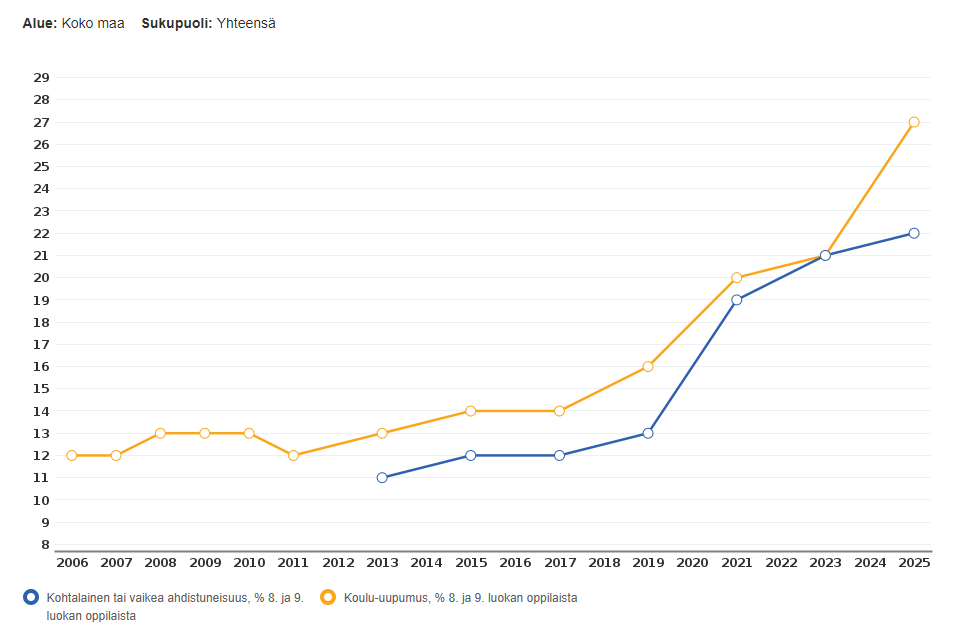
Oma tämän kertainen harrastuneisuuteni kohdistuu nuorten ahdistuneisuuteen ja uupumukseen. Ei, tuossa kynnyksen kohdalla ei kysely oleellisesti muuttunut; sama GAD-7 on ahdistuneisuuden arvioinnin taustalla ollut indikaattorin kuvauksen mukaan koko ajan.
Vuosien 2017 ja 2020 välissä tapahtui hirveästi kaikenlaista: mm. yksi koronapandemia. Myös enenevästi algoritmisesti kontrolloidun sosiaalisen median ja lyhytvideoiden suosion nousu ajoittuisi ehkä ajallisesti uskottavaan kohtaan. Yläkouluissa otettiin myös käyttöön vuonna 2014 vahvistettu uusi opetussuunnitelma vuosina 2017-2019. Silloin tunne- ja mielenterveystaidot tulivat osaksi opetusohjelmaa. (THL:n työpaperi Mielenterveyden edistäminen kouluissa on vuodelta 2013 – jolloin yllä olevan kuvaajan ilmiötä ei vielä tilastoissa aivan tällaisena nähty.)
Tilastoista nähdään aika helposti, mitä kaikkea ei voida syyttää tästä ilmiöstä, koska se ei vaikuta tapahtuneen samaan aikaan.
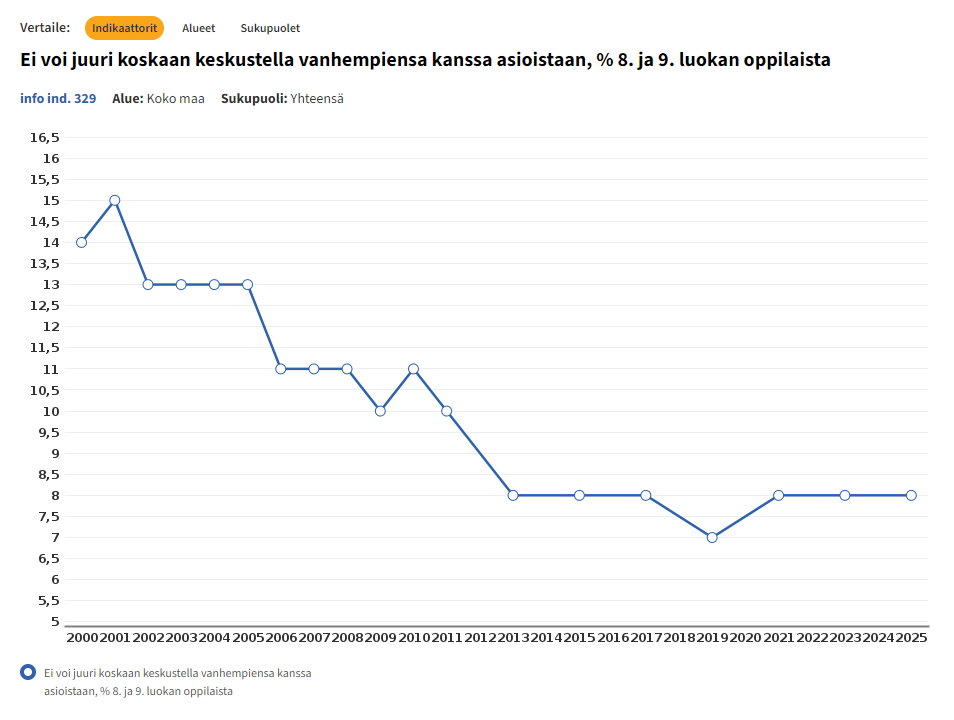
Sitten 2000-luvun alun niiden nuorten osuus, jotka kokevat, etteivät voi juuri koskaan puhua vanhempiensa kanssa asioistaan on puolittunut. Vanhemmuus ei siis välttämättä ole erityisen hukassa, ei ainakaan kohtaava sellainen.
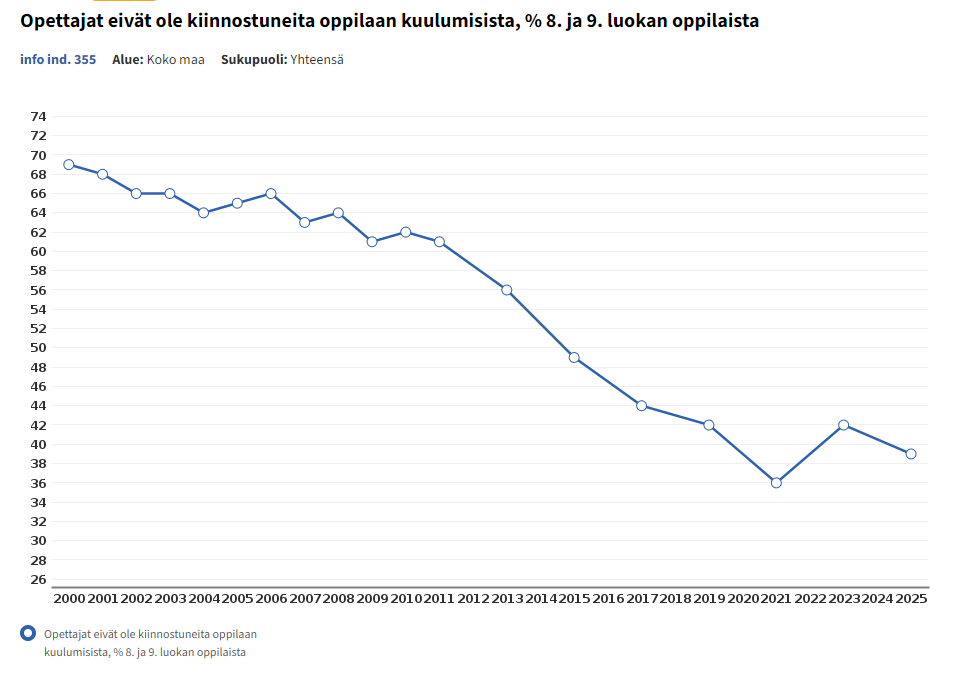
Ja opettajat ne vasta ovatkin petranneet oppilaistaan kiinnostumisessa 2000-luvun aikana!
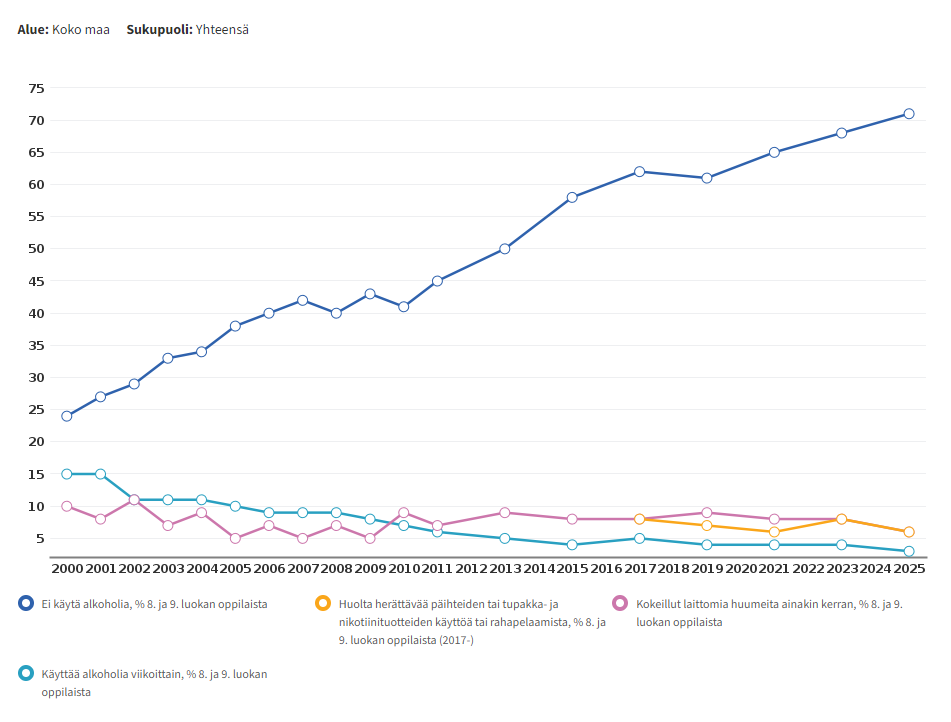
Päihteitä nuoriso ei ole äitynyt käyttämään. Meillä on kyllä kasvava huumeongelma, mutta se koskee onneksi vielä niin pientä osaa nuorista, ettei mitenkään voi selittää miksi joka neljäs kokee koulu-uupumusta.
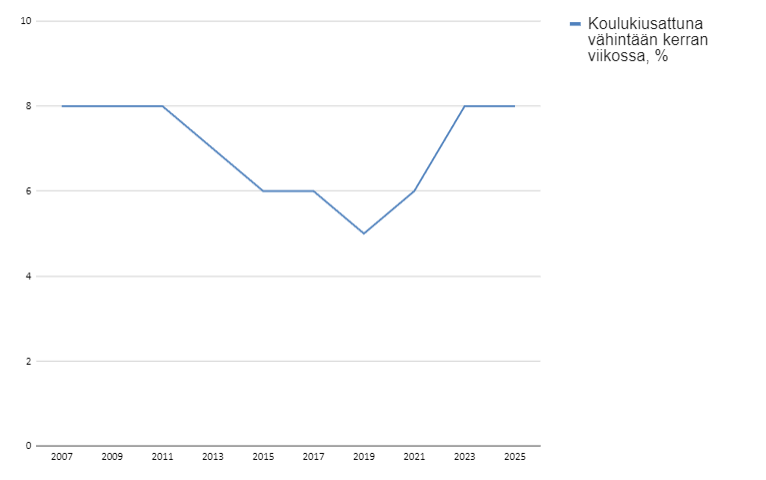
Kiusatuksi jatkuvasti tulevien osuus on mukavan notkahduksen jälkeen noussut takaisin 2000-luvun 1. vuosikymmenen tasolle, mutta ahdistuksen ja uupumuksen kaltaista massiivista nousua siinä ei nähdä. (*)
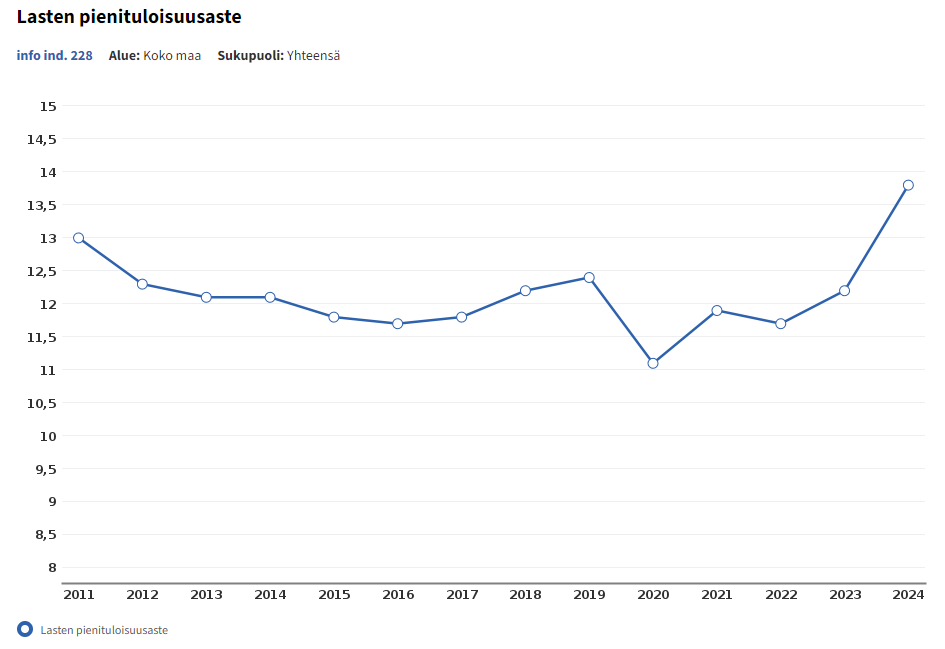
Pienituloisuutta olisi toki aina kiva epäillä stressin taustaksi, mutta alaikäisten pienituloisuus ei ole Tilastokeskuksen tulonjakotilaston mukaan erityisesti muuttunut ahdistuksen ja kuormituksen kanssa samaan aikaan (vaan vasta sen jälkeen, mutta siitä jossain toisessa yhteydessä).
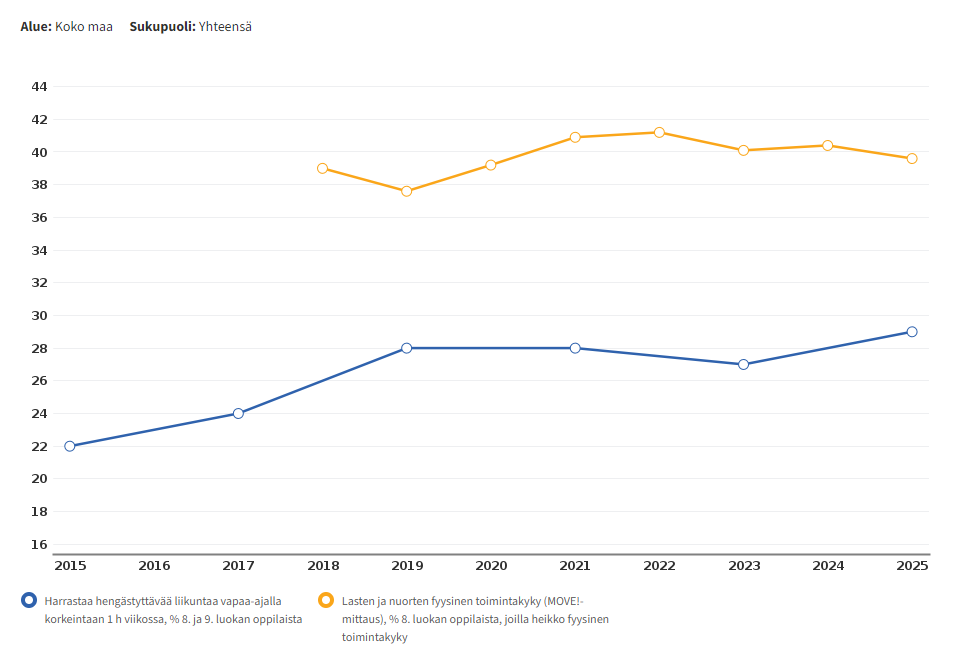
Liikunnan puutetta ja huonoa fyysistä kuntoa on myös aina kiva syyttää kaikesta, mutta siitä ei ehkä myöskään ole kyse. (Ei mennä nyt tässä myöskään mielipiteisiini MOVE-testeistä ja niiden normeista.) Vähän liikkuvien osuus kyllä kasvoi jonkin verran vuosina 2015-2019, mutta on sittemmin pysynyt aika samana samalla kun uupumuksen määrä jatkaa nousuaan.
Sitten tilastoihin, joissa ehkä on nähtävissä jotain samansuuntaista.
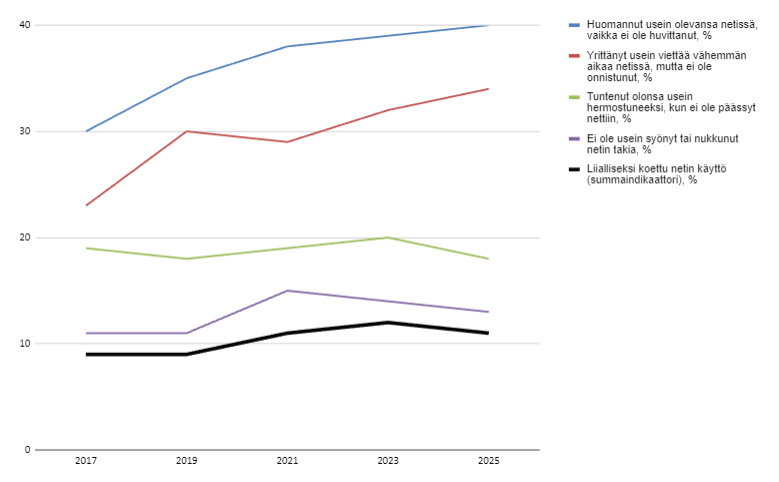
Netin käytön ongelmallisuutta nuoret raportoivat vähän enemmän kuin ennen: 2017 jälkeen niiden nuorten osuus, jotka ovat huomanneet roikkuvansa netissä vaikka ei huvittaisi ja niiden, jotka ovat yrittäneet lopettaa mutta eivät ole onnistuneet, on kasvanut. Toisaalta kokonaisindikaattori ei ole ihmeesti heilahtanut. Tilasto ei valitettavasti ulotu kauemmas historiaan. (*)
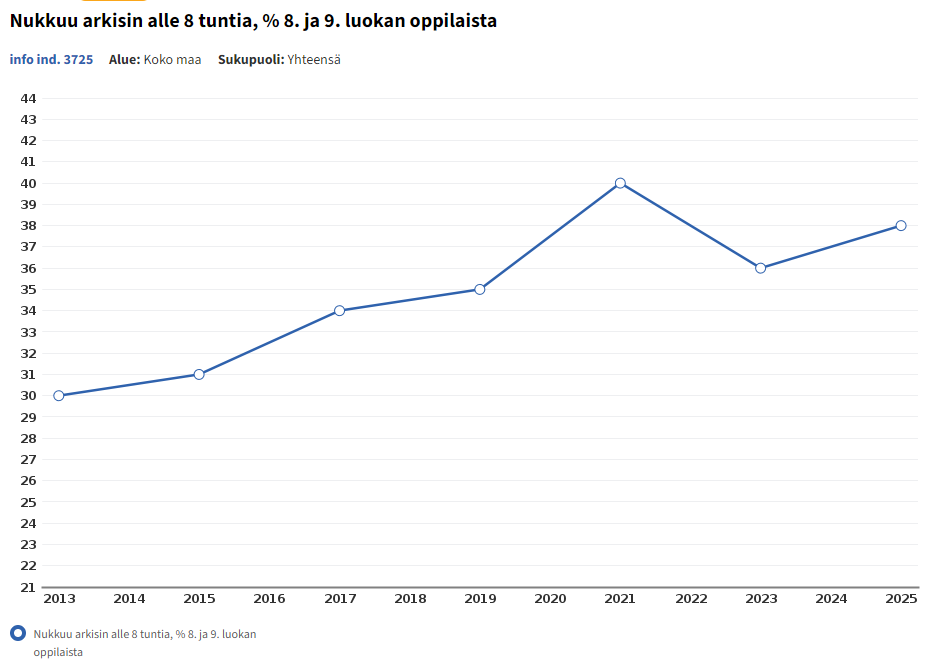
Riittämättömästi nukkuvien osuus on sekin kasvanut. Trendi on alkanut jo kauan sitten. Luulisi että pandemian aikana kun ei tarvinnut herätä ihan joka aamu fyysisesti koululle tilanne olisi parantunut, mutta itse asiassa kävi päinvastoin… Liian vähän todennäköisesti nukkuvien osuus on nyt tarpeeksi suuri, että se voisi teoriassa selittää vaikka kaikenkin koulu-uupumuksen. Kuitenkin vuonna 2015 alle 8 tuntia nukkui lähes kolmasosa, mutta uupumusta raportoi alle puolet siitä. Siksi se ei yksinään voi olla ilmiön selittäjä, vaan jotain muutakin on muuttunut.
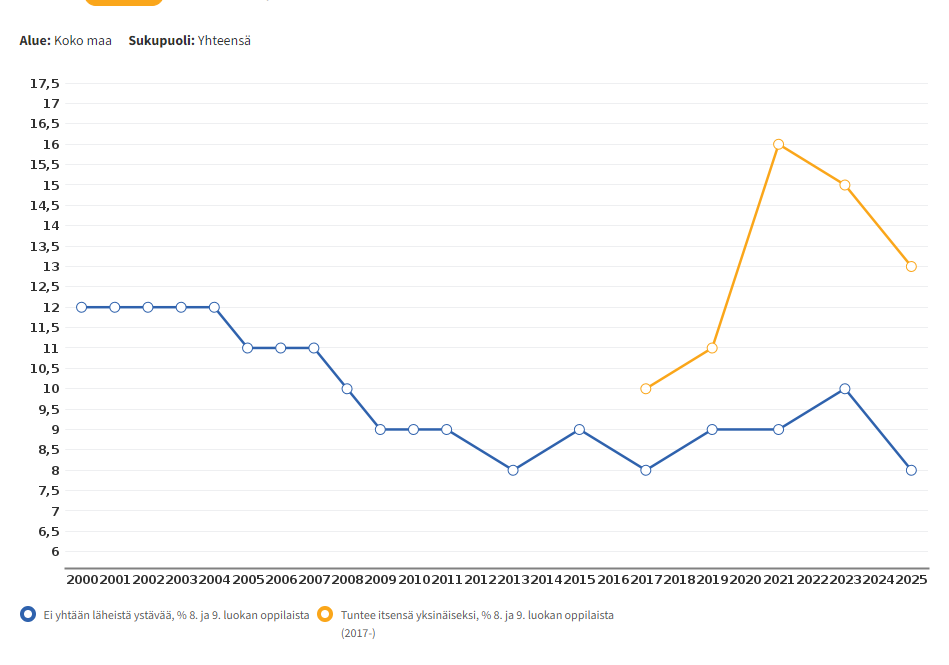
Yksinäisyyttä kokeneiden osuus kasvoi pandemian aikana hurjasti, mutta on laskenut sittemmin kuitenkin taas melko nopeasti. Vähintään yksi hyvä ystävä on jälleen yhtä monella kuin oli ennen tuota ahdistuksen huippua.
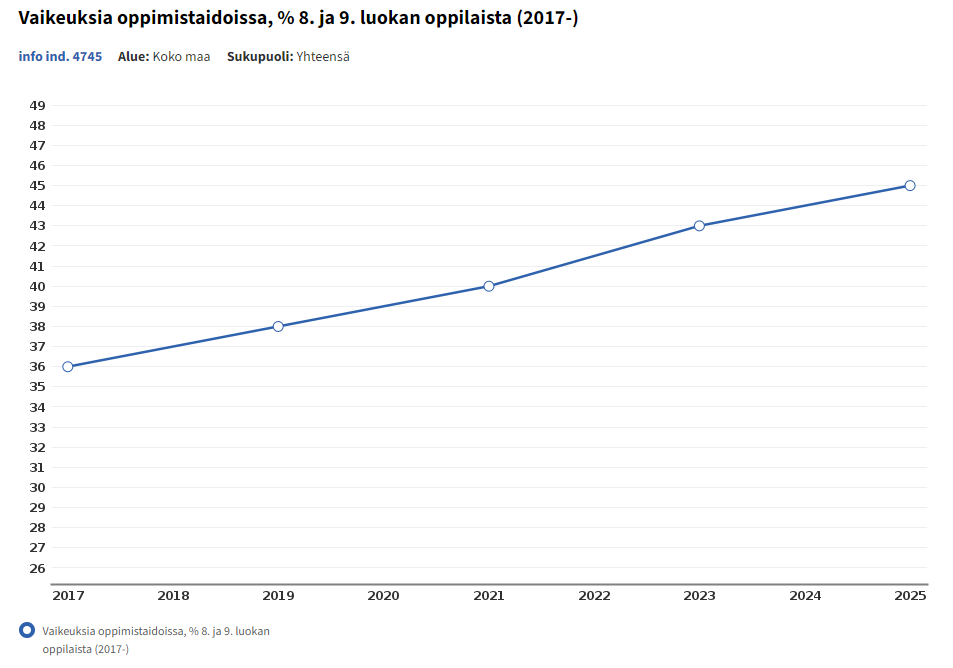
Yhä useampi lapsi ja nuori kokee vaikeuksia koulunkäynnissä ja tämä osuus on kasvanut ja kasvaa tasaisesti.
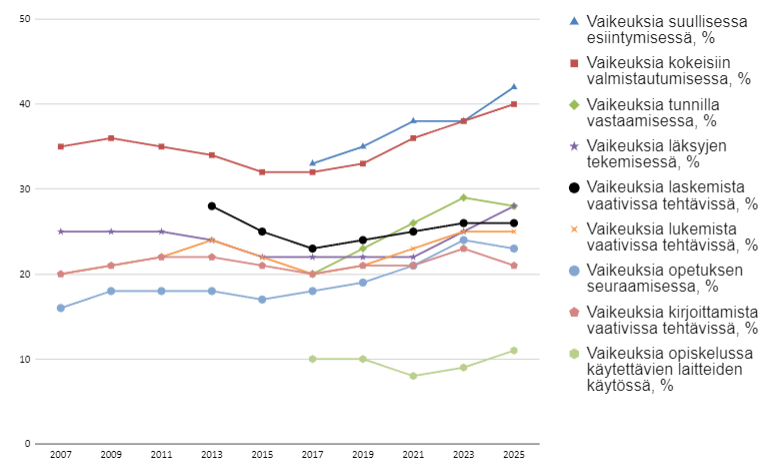
Ja jos vähän tarkemmin katsotaan mistä tämä summamuuttuja muodostuu, niin yläasteen oppilaat raportoivat enenevästi vaikeuksia suullisessa esiintymisessä, kokeisiin valmistautumisessa, tunnilla vastaamisessa, läksyjen tekemisessä ja opetuksen seuraamisessa. (*)
Mikä on syy ja mikä seuraus? Sellaisten ajatteleminen ei näissä hommissa ole helppoa. Kun ihminen on ahdistunut, ei hän jaksa opiskella. Toisten edessä esiintyminen ja näyttösuoritukset saattavat silloin myös tuntua vaikeilta, vaikka eivät ole. Ja jos nukkuu liian vähän, silloin ei jaksa opiskella. Ja jos on koulustressiä, nukkuu huonosti… Toisaalta opetussuunnitelma muuttui juuri silloin kun työ alkoi tuntua vaikeammalta, joten ei voida poissulkea sitäkään, että uupumus ja ahdistuminen johtuu siitä, että koulutyö on nyt jollain lailla vaativampaa. Ja oliko mielenterveystaitojen tuominen opetusohjelmaan niiden lisääntymisen mahdollinen syy, kuten ajallisesta yhteydestä voisi nopeasti vilkaisemalla päätellä, vai ennemmin “too little, too late” -reaktio hiljaisena alkaneeseen ja jo havaittuun trendiin? Ratkaisu ongelmaan se ei ainakaan vaikuta olleen.
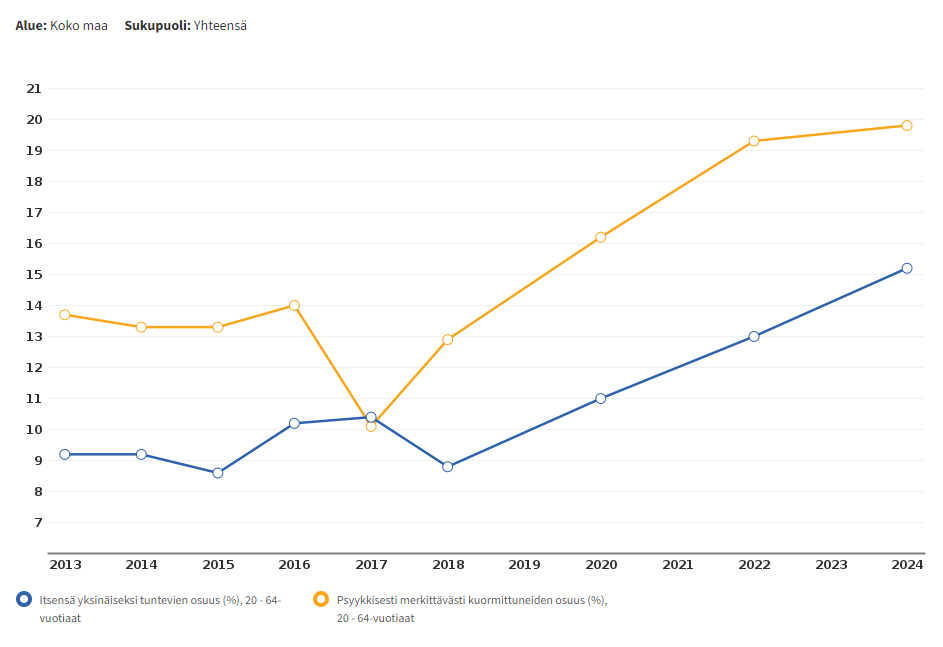
Lopuksi on hyvä muistuttaa, että vaikka puhumme nuorista, meidän pitäisi oikeastaan puhua nuoristakin. Myös työikäisten joukossa itsensä kuormittuneiksi ja yksinäisiksi kokevien osuus on samana aikana lisääntynyt. (Datan lähde on Terve Suomi -kysely.)
(*) Sotkanet ei jostain syystä halua jakaa minulle kaikkia käyriä, niin osa piti piirrellä “käsin” elikkä Google Sheetsissä.
Professori emerita Liisa Keltikangas-Järvistä siteerataan usein minusta eri keskusteluissa hassusti. Nyt viimeisimpänä kiertää sitaatti Oskari Onnisen jutusta Uudesta Jutussa:
“Keltikangas-Järvisen mielestä suomalaisista sotaveteraaneista kannattaisi ottaa oppia, sillä he osasivat käsitellä kokemuksensa ”äärimmäisen tehokkaasti”. He eivät jääneet vellomaan tunteisiinsa, vaan laittoivat ne sivuun ja alkoivat rakentaa Suomea. Heidän suuresta enemmistöstään ei tullut passiivisia uhreja vaan aktiivisia selviytyjiä.”
Tätä kontekstista irroitettua sitaattia tuohtuneet ihmiset tulkitsevat niin, että olisi professorin mielestä hyvää tunteiden käsittelyä “juoda viinaa ahdistukseensa ja kurittaa lapsiaan ruumiillisesti”, siteeratakseni erään nykyajan ihmisen arviota sotien jälkeisestä tunteiden säätelystä.
Itse kuitenkin ajattelen, että professori Keltikangas-Järvisen varsinainen pointti kiteytyy sanoihin “suuri enemmistö”. Suurin osa sodan kokeneistakaan ihmisistä ei ollut väkivaltaisia juoppoja. Ei voida kategorisesti sanoa, että senaikaiset ihmiset “eivät osanneet käsitellä tunteitaan” yhtään sen enempää kuin ei voida sanoa, että nykyaikana ei osata. Osa osaa, osa ei. Se päti silloin ja pätee edelleen.
Tunteiden säätely kun on sellaista, että kaikilla menee pieleen joskus, ja kaikkina aikoina on olemassa ihmisiä, joilla menee pieleen usein. Ei tietenkään pidä paikkansa, että nykyään ei ole väkivaltaisia tai arvaamattomasti raivoavia tai juoppoja ihmisiä. Heitä on, ja heitä on niidenkin joukossa, jotka ovat saaneet nykyaikaista terapiaa tai muuta tukea, ja niidenkin joukossa joille on opetettu tunnepuhetta nykyaikaiseen tapaan lapsesta saakka. Toisaalta viisas kirja nimeltä “Kasvatus ilman selkäsaunaa” on vuodelta 1909 ja toisaalta edelleen Suomessa käytetään silmitöntä kuritusväkivaltaa lapsiin syynä aikuisen responssi omiin traumoihinsa.
Se narratiivi, että ennen hoidettiin ongelmat viinalla ja väkivallalla ja se oli kaikista ihan ok, mutta nykyään kun puhutaan tunteista ja on terapiaa, semmosta ei enää ole, on siis radikaali yksinkertaistus ja potentiaalisesti ihan höpöhöpöä. Moraalinen suhtautumisemme kuritusväkivaltaan ja perheväkivaltaan yleensä on muuttunut ja puuttumiskynnys alentunut ja se on hyvä, mutta se kuinka suuri osa tässä on “tunteiden käsittelyllä” nykyaikaiseen tapaan on omankin käsitykseni mukaan aika avoin kysymys. Päissään tehty silmitön pahoinpitely ei ole kuulunut yleisesti hyväksytyn kuritusväkivallan piiriin silloinkaan, kun Koivuniemen herra vielä uhkaili vierailla joka kodissa. Ahdistuneisuus taas ei ainakaan näytä vähentyvän, vaikka toki dataa menneiltä vuosilta on vaikeaa saada, koska käsitteellistys on muuttunut niin paljon. Ja päihdeongelmaiset teillä on edelleen keskuudessanne.
Siihen nähden, kuinka iso trauma nuo sodat Suomelle olivat, niistä selvittiin lopulta ihmeellisen hyvin. Valtaosa ihmisistä jatkoi elämäänsä onnistuneesti ja jälkeläisistäkin tuli aivan täyspäisiä, joiden isoin ongelma on hämmennys siitä, että näistä asioista ei puhuttu. Elämä jatkui ja jälleenrakennus onnistui. Osa ihmisistä ei toipunut ja ne tarinat ovat traagisia ja isovanhempiemme sotakokemusten seuraukset elävät meissä edelleen. Ei silti ole mitenkään sanottua, että samanlaisesta koko kansakuntaa koskevasta traumasta selvittäisiin tänä päivänä yhtä hyvin tai yhtä vähillä vaurioilla tai yhtä monessa sukupolvessa. On helppo patsastella omassa tunnekäsittelyn erinomaisuudessamme, kun vastaavaa traumatisoitumisen määrää taustalla ja vastaavia töitä tehtäväksi ei ole, vaan on saatu (kansakuntana, yksilöihin en ota kantaa) aloittaa sen suhteen aika helposta lähtötilanteesta. Toivottavasti ei tarvitse tulevaisuudessakaan testata, mitä kävisi jos lähdettäisiin samalta takamatkalta.
Kun puhutaan, että ei sillon ollut mitään traumaterapiaa eikä annettu tukea, unohtuu myös se, että maassa ei ollut käytännössä ketään, joka ei olisi kokenut sitä samaa traumaa joko suoraan tai 1. asteen kontaktien kautta. Siltä pohjalta on melko vaikea lähteä pystyttämään mitään psykiatrisen tuen järjestelmää, vaikka olisi miten nykyaikainen käsitys siitä, miten tuen pitäisi hyvässä tapauksessa mennä. Erityisesti toivon itsekkäästi oman työni puolesta, että psykiatrisen tuen järjestelmää ei tarvitse lähteä yrittämään niissä olosuhteissa. En nimittäin menisi vannomaan, että resilienssi riittäisi moiseen, kun ei se aina tahdo riittää resurssipulaan rauhanaikanakaan. En pitäisi mahdottomana, että todettaisiin, että siitä, että traumatisoituneet terapoi toisia traumatisoituneita tai ryhmäkeskusteluista siitä kuinka kamalaa oli ja on ei oo mitään hemmetin hyötyä, ja paras kriisihoito on stabiili arki, ja sen turvaamiseksi puhuminen, joka kriisiyttää puhujat, on vasta-aiheista. Joudummehan joskus nykyäänkin niin toteamaan. Terapian aika ei aina ole silloin, kun ihmisellä on pieniä lapsia huollettavanaan.
Eikä meidän pidä väheksyä veteraanien muodostamia sakkeja, joissa asioista pystyi puhumaan eri lailla kuin kotirintamalle, sitä että lapsille osattiin selittää, että setä on omituinen koska sen mieli vaurioitui sodassa, tai sitä, että tärkeintä oli leipä pöydässä ja vaatteet päällä ja kouluun meno ja elämän jatkuminen. Ihan niitä samoja menetelmiähän me edelleen kriisityössä käytetään, vaikka niitä nyt sanotaan “vertaistueksi” ja “psykoedukaatioksi” ja “vakauttamiseksi”.
This post was originally a Mastodon thread. In it, based on some discussions ongoing in different contexts, I laid down things I considered truths. People seemed to like it, and as my Mastodon posts are ephemeral, I will document them here now. So: welcome to my not-TED talk, aka Dr Wessman’s First Ten Truths.
Yes, the name of this post is intended as ironical. Sheesh.
Relevant background of mine: I am a child psychiatrist working in children and youth community level mental health services. I hold a PhD in data analysis. I’ve dabbled in practical epidemiology. I am a parent. My values can be described as left liberal. I am not a psychotherapist.
One. Humans did not evolve in conditions where being easily content was a survival trait. It was better to get a little restless and start looking for things to improve and food to store than to sit around feeling nice. Your mind does not exist to make you feel good. It has evolved to help you survive in extreme conditions. Calm, content, peace of mind, etc are not the default normal state of a human being. Periodically rising restlessness, that pushes us to Do Something is what is “normal”.
Two. In fact, if you always were 100% happy and content, you would die of thirst. Discontent and unhappiness caused by the thirst is what gets you off the sofa and to get a glass of water. When things are wrong and you can and need to do something about that, it is appropriate to feel bad – anxious, angry, depressed, in pain, whatever. The goal is not “to feel good” all the time.
Three. So-called “negative” emotions should function like an instrument panel. It has gauges and warning lights to tell you that something might be wrong. The gauge on red or the light is not a problem as such. Getting rid of warnings altogether would be dangerous (see previous point). But it is also not always an emergency. It can warn you about a thing you already have a plan to deal with. It might warn you about something you cannot fix and just have to live through. Or it can be broken.
Four. There is no “real you”. It is normal and healthy that you are different in different situations and that sometimes you have to struggle to present in a socially fitting way. All of the versions of you are “real” even if some are more comfortable than others. Feeling awkward in a social situation is not a sign that something is wrong. Awkwardness is a feature of complex situations. It tells you something new, interesting or important is happening or about to happen.
Five. Because there is no “real you” and we all are formed in social contexts, to some extent everybody “masks”. It is as such not a sign that something is wrong. However, people differ a lot on how much work this all is. Everybody has the right to try and arrange their life so that they do not need to struggle all the time. No one has the right to expect to feel comfortable all the time. This means that people with more flexibility need to adjust to others more to make room for everyone.
Six. You might have noticed that I have refrained from using diagnostic words in this post. I will continue to do so. Medical diagnoses have their uses in medical contexts. Outside of it, categorization of humans into medical groups almost always does more harm than good. Categorical groups are strict and narrow and fail to capture the true variety and the true similarities of human beings. It makes sense to decide how to treat you based on your diagnosis only if you are my patient.
Seven. Humans do not neatly divide into two distinct groups of neurotypical and neurodiverse. At least 85% of people have some “neurodiverse” feature (I am almost face blind and a couple of other things myself). Around 50% of people have several. The ends of the spectrum are rare. Neither neurotypical nor neurospicy people are all the same, and most people are somewhere in between anyway. Binary division works here as badly as it does with gender.
Eight. Just like the socially acceptable you that you struggle to present is real, the you who does bad shit is real. It makes no sense to say of someone who acts violent or racist or sexist or mean, “they are not really like that”. If they do those things they are a person who does those things. They might be a person who does not want to, and wishes to do better. That’s great and we should help them. It does not make the things they do less real, though.
Nine. We really need to go back a little on what “nursing” and “healing” mean. In many mental health problems, treatments alone do not heal. Mental growth, regular healthy life, and supportive social contexts do. Treatments – and medicines and therapies have this in common – are often necessary, but to remove obstacles and increase flexibility, not to do the work. Mental health problem prevention is mostly social policy and the work of politicians, not doctors and nurses.
Ten. In the end, none of this matters. There is no “meaning of life”. Values are a human social construct, and the universe does not give a damn. Only people do. That means that you are 100% free to choose what matters to you. If you are a good person who wants to do good – and the vast majority of us are – you do not have to justify it. Because nothing matters, it does not matter if it is naive. Or hopeless. Or idealistic. Or meaningless. Or cringe. You really can be good just for the hell of it.
Thank you for reading! Despite the name of this post, there are no further truths for now, but there might be! Or not.
Kävin vastikään kirjastossa hakemassa varauksiani. Etsiessäni appiksesta sitä, millä koodilla mihinkä kohtaan noutohyllyä pyytämäni teokset (*) on piilotettu, muistin että aikanaan kirjat olivat siellä hyllyssä ihan nimelläni. Sitten niihin sai noutoa varten halutessaan laittaa nimimerkin. Ja nykyään sitten tämä koodi, ei suinkaan omaa koodia minulle, joka noudolle aina eri koodi, yksi kirjain ja kolme numeroa. Tätä perustellaan tietysti tietosuojalla: eihän toki käy päinsä, että sieltä kirjaston hyllystä voisi joku huomata, saati tahallaan urkkia, mitä tohtori Wessman kulloinkin lukee.
Tohtori Wessman toki omasta halustaan aina jaksaessaan julkaisee listaa lukemistaan kirjoista kaiken kansan nähden internetissä ja mieluiten löytäisi kirjat hyllystäkin appista taskusta kaivelematta, edes joka kerta samalla muistettavalla nimimerkillä tai koodilla, jos ei koko nimeä pidettäisikään suotavana hyllyn reunaan laittaa. Sellaiselta hulluudelta on kuitenkin katsottu, että on paras häntä suojella minkä pystyy. Yritetään nyt ainakin estää se kirjaston hyllyillä lukemisestaan kailottaminen, vaikka sosiaalisen median kieltäminen aikuisilta ei olekaan vielä ottanut tuulta alleen.
Kaipailemme maailmaan, tai ainakin Suomeen, usein lisää yhteisöllisyyttä. Samaan aikaan jopa kirjastosta tilatut kirjat ovat niin salainen asia, että edes yksilöön kytketyllä salakoodilla niitä ei laiteta hyllyyn odottamaan, vaan joka noudolla on oma koodinsa. Kuitenkin on niin, että yhteisöä on vaikea luoda sinne, missä ihmisiä pidetään erillään. Jotta yhteisö voi tilanteen tullen toimia, sen pitää ensin olla olemassa. Vähän niin kuin jos ei teini-ikäiseen ole keskusteluyhteyttä tavallisessa arjessa, ei sitä useinkaan synny yhtäkkiä sitten, kun olisikin Vakavaa Puhuttavaa.
Yhteisöllisyyttä rakentaa arjessa paitsi kerhot ja kuppikunnat ja kohtaamispaikat myös se, että kirjastossa voi huomata, että Marttinen on tilannut sen saman kirjan kuin minä, ja voi sitten seuraavan kerran raitilla nähdessään kysyä, että mitä Marttinen tykkäsit, minusta se oli sittenkin kyllä aika tylsä. Se, kun kuulee pankin odotustilassa huudettavan jotain omasta mielestä harvinaista nimeä ja tilaisuuden tullen kysyy, että olettekos te sukua sille toiselle samannimiselle täälläpäin. Se, jos kuulee koulussa omaa lasta hakiessa, että saman luokan Emmi-Oskarilla on jalka poikki, ja saakin päähänsä laittaa viestiä, että tarvitaanko siellä lapsenvahtia tai toipilaalle seuraa.` Ja siellä koulun pienoismaailmassa yhteisöllisyyttä lisää vaikkapa se, että koulukuraattori kuullessaan opettajien puhuvan välkällä tapahtuneesta nelosluokkalaisten välisestä kiusaamistilanteesta voi sanoa, että hei kuulkaa, kun mä arvelen, että se neljäbeen Osmo-Susanna kertoi samanlaisesta jo viime viikolla, nyt taitaa olla tarpeen katsoa vähän tarkemmin mitä täällä tapahtuu.
En missään tapauksessa tarkoita, että että koulujen, pankkien ja kirjastojen oikeutta paljastaa tietoja heillä asioivista ei pitäisi mitenkään säädellä. Enkä myöskään tarkoita todellakaan, että vaikkapa terveysaseman aulassa voisi kailottaa vaikkapa, että seuraavaksi katsotaan sitä Marttisen alapäätä, tai että ei tarvitsisi olla hienotunteinen siinä, kertooko koko vanhempainyhdistykselle, että alkuperäinen tieto tästä sekoilusta tuli nimenomaan neljäbeen Osmo-Susannalta. Juoruilu yleensäkin on rumaa, ja yhteisöjen kääntöpuoli on se, että yhteisö saattaa myös kääntyä erilaista vastaan.
Mutta pitääkö oletusarvon siltikään aina olla aivan ehdoton kielto ja kaiken salaaminen niin pitkälle, että kirjaston noutohyllyllä pitää tehdä monimutkainen järjestely, jottei yhdenkään kirjan lainaaja voi vahingossakaan paljastua? Ja eikö ihmisellä pitäisi olla paitsi oikeus halutessaan kieltää tietojensa luovuttaminen, myös positiivinen oikeus omiin tietoihinsa? Esimerkiksi lupa sanoa, että haluan että kirjani ovat noutohyllyssä aina oman valitsemani nimimerkin kohdalla eivätkä kryptisillä koodeilla siellä täällä, tai että puhelinnumeroni saa luovuttaa luokan lasten toisille vanhemmille ellen jatkossa erikseen kiellä, ja että todellakin haluan että opetushenkilökunta ja oppilashuolto jakavat keskenään tietoa lapseni tarpeista, heti kun sellaisia tulee esiin, ilman että täytättää minulla joka kerta erillistä kirjallista lupalappua.
Yhteiskunnallinen puheemme vaatii samaan aikaan pitämään arvona sitä, että kukaan ei koskaan saisi vahingossakaan tietää kenestäkään mitään, ja sitä, että muodostamme yhteisöjä joissa ihmiset ovat kiinnostuneita ja huolehtivat toisistaan. Siinä on tiettyä ristiriitaa. Tietosuojakin on tietysti arvo. Se ei vain aina voi olla ainut arvo, joka eri tilanteissa pitää huomioida. Minä haluaisin kirjastossa pitää tärkeämpänä varauksen noutamisen sujuvuutta, eikä minua suinkaan yleensä haittaisi, jos joku tuttava huomaisi minun lukeneen tietyn kirjan. Terveydenhuollossa asioidessani minulle olisi tärkeämpää varmistaa, että tietoni aina varmasti tarvittaessa siirtyvät ammattilaiselta toiselle, kuin että niitä ei missään olosuhteissa siirretä ilman nimenomaista lupaani.
Nyt joku muu on kuitenkin päättänyt nämä asiat puolestani.
(*) Leena Krohnin Kotini on Riioraa, joka on unenomainen kuvaus lapsuudesta 1950-luvulla, ja Ruunulinna, Jacob Lagervallin vuonna 1834 kirjoittama kalevalamittainen mukaelma Shakespearen Macbethistä. Mainitsen tällä kertaa noutamani teokset nimeltä tässä vain, koska ne antavat minusta eksentrisen, sivistyneen ja aivan virheellisen kuvan.
Cashew paste. N dl cashew nuts, N/2 dl of cold water, some boiling water. Soak cashews in boiling water for 15 minutes. Drain. Add the cold water, blend cashews into paste. Goes with everything from oatmeal to chili, keeps in the fridge for a small forever. You are welcome.
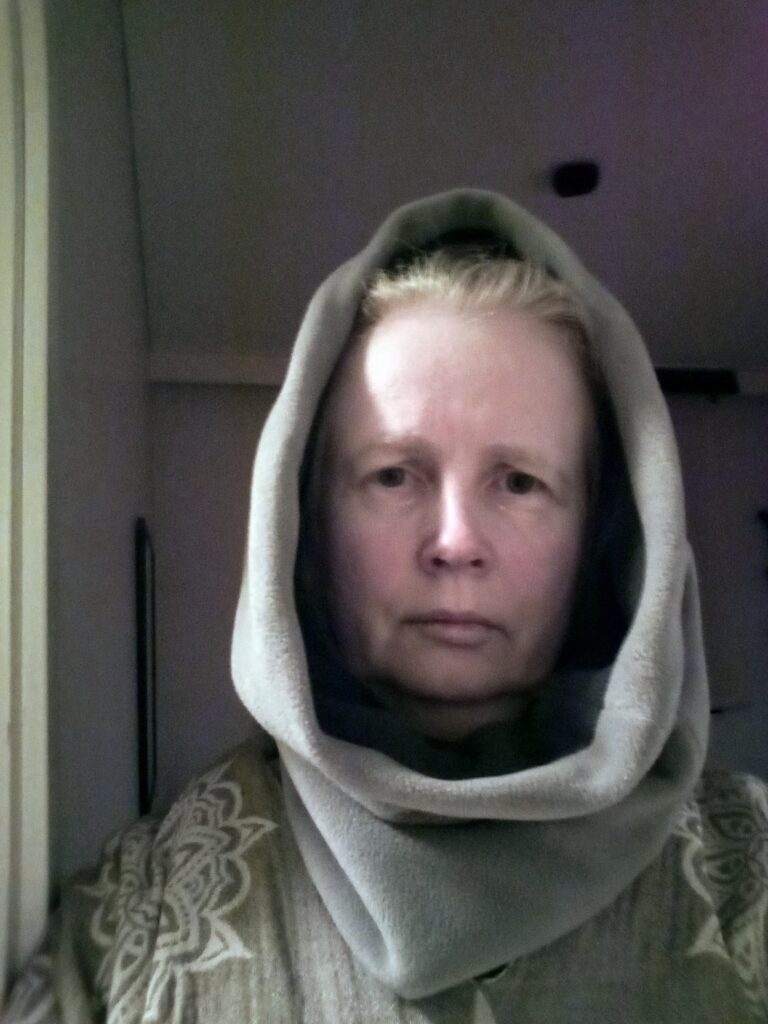
A big tube scarf of double fleece beats used as a hood beats wool caps / beanies for warmth. If you pull your winter coat hood over it is basically storm proof for both your head and your neck. It also helps you keep warm when you are chilly indoors better than adding another layer of wool sweater does. But it’s gotta be big. The skin tight ones don’t work the same. Please see attached picture of tired lady for reference. I have no idea if wool would work the same way but it’d probably be too scratchy for me.
MDF book nook kits. It’s like scale models straight from 1980s except material technique has taken some serious steps forward since, you can use water soluble glue instead of ending up with everything in the disaster zone superglued together, and everyone thinks themes other than military count as cool. As an added bonus, you do not need a separate space to display them, I can just put them on the bookshelves we have anyway.
Also yes, topics on this blog will be totally random. I have truly gone back in time with this thing. I will probably add things from my past web appearances in a slow, non-coherent manner too.
Check the sidebar on the left to find me on Goodreads, Bluesky, and Mastodon, and to pick up the RSS URL to this thing.